Δ1 - Wave Function Collapse
BREAKING: Ambition lands in the present, becomes reality-sized

There are as many kinds of future as there are kinds of weather. There are projected futures ("The Fed is poised to lower interest rates") and forecasted futures ("70% chance of snow"). There are patriotic futures ("mission accomplished") and emotional futures ("we will remember you forever"). Some futures are like secular prayers ("the long arc of history bends toward justice"), and others name what scares us, or what should scare us ("World War 4 will be fought with sticks and stones"). There are futures we use to name intent ("the enemy will not cross this line"), to set boundaries ("if you use that word again, I'm gone"), to ask questions ("how do we let our children build a life without us?"), and to shatter assumptions ("It's time for humans to understand that property is death").
Of all these sorts of futures (and the others I study at my job), I'll direct your attention now to the future of Friday morning, or the first day of summer, or the college graduation, when everything is full of light and there's no end to all that might happen, and all that you might do. There are established words for this already, of course - we might say that you have high expectations, or that your whole life/summer/weekend is ahead of you. But like all language, those phrases are maps imposed on a strange and shifting territory, like drawing the border of a beach: useful, but necessarily incomplete. There's a certain quality missing in those phrases (even if it's often implied when folks invoke them): what one sees ahead is much larger than the actual days/months/years can contain. What will I do this summer? I'll take a job and ride the ferry to Estonia and eat berries under the midnight sun. I'll also finish my novel, and see a moose, and watch all these TV shows, and by September I'll have been made new to myself by adventure. In moments when the future feels wide open, it becomes a clamor of every possibility announcing itself at once.
In quantum mechanics, we have something called a wave function. It's very likely been described to you before. You may have encountered Schrödinger's cat, both alive and dead in its box. Maybe you've also heard of the experiment in which a small particle, fired at a metal plate with 2 slits cut into it, seems to go through "both slits at once." As with all things in physics, though, if you have not worked with the Schrödinger equation, you have only read the wave function in translation; and as with all translations, we can bring it into English differently, toward different ends.

When we are not observing a particle (or any other very small thing), we do not know where it is. So far so good, right? Okay, so let's say we drop it off somewhere, like in the middle of a box. At the first instant, we know exactly where it is and in which direction it's moving. Small particles tend to move around erratically, though, so with time we lose certainty about its location. The range of places we might expect to find it (if we were to look again) radiates outward, like the ripple from a pebble tossed into a pond. As it turns out, this "wave" of probability spreads exactly like a wave, actually. The wave function is an equation (or function) we use to describe the probability of finding the particle in any given location at any given time.
What's freaky about quantum mechanics is that the particle's probability behaves like a wave in ways we truly wouldn't expect. Waves bounce off of surfaces and, traveling back in the opposite direction, interfere with themselves. The particle's probability also does that.
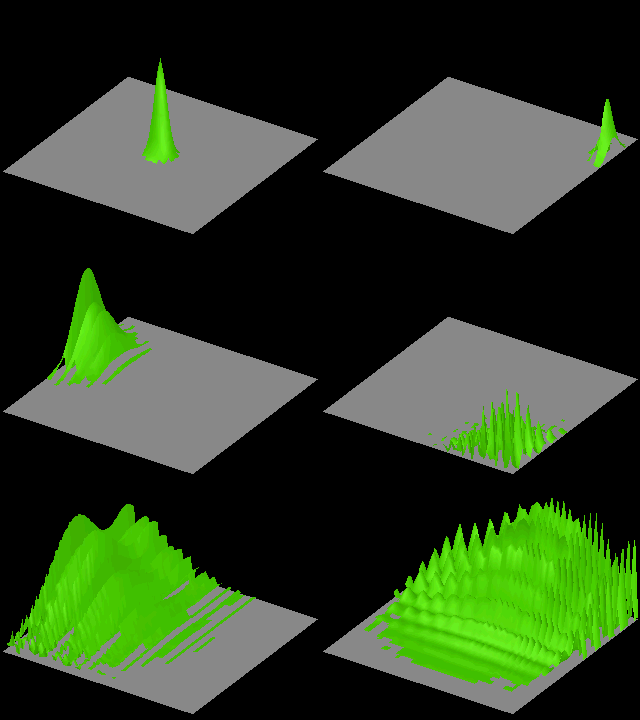
If you put 2 slits in front of a wave, it creates an interference pattern. A particle's probability does that too!
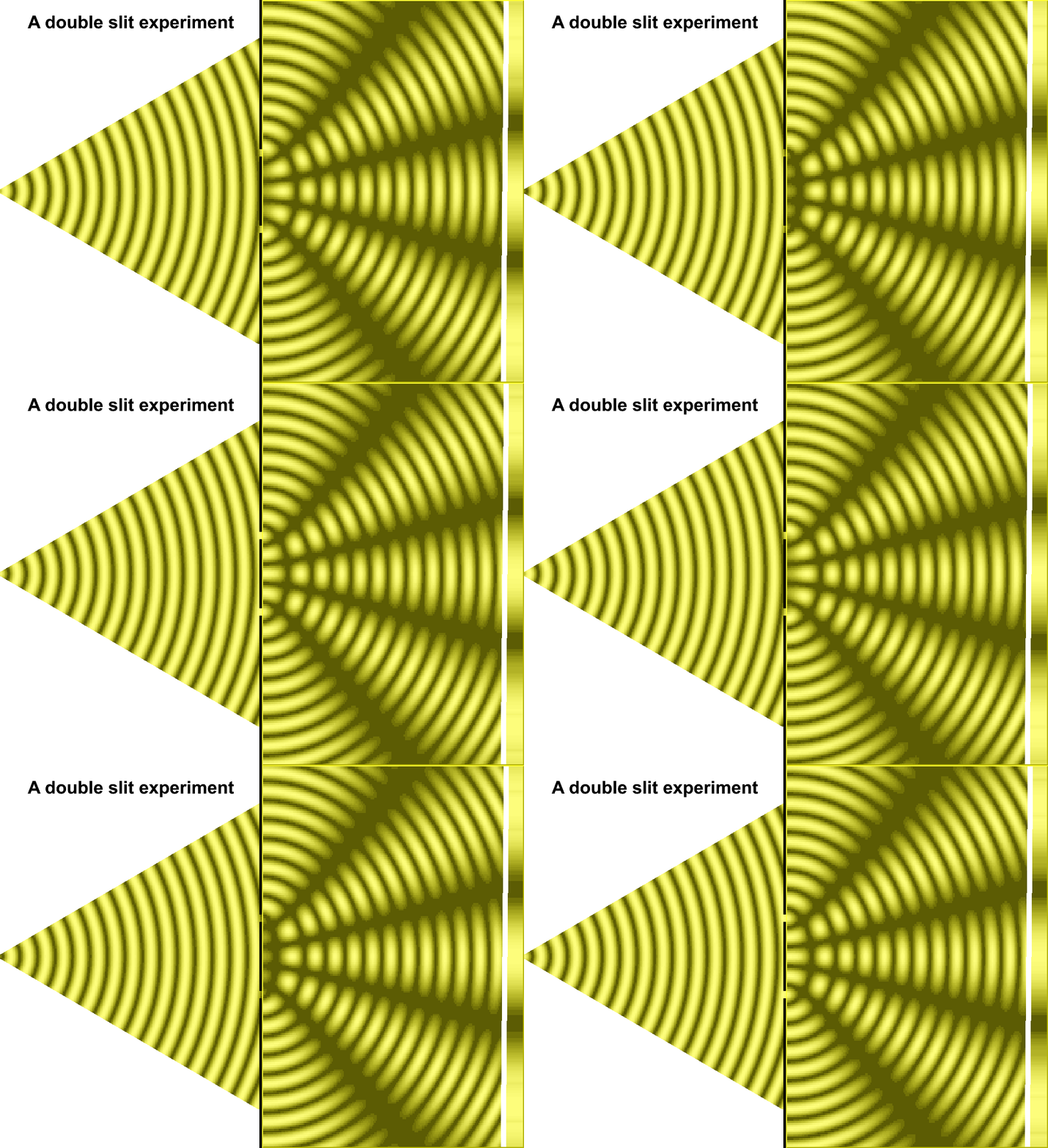
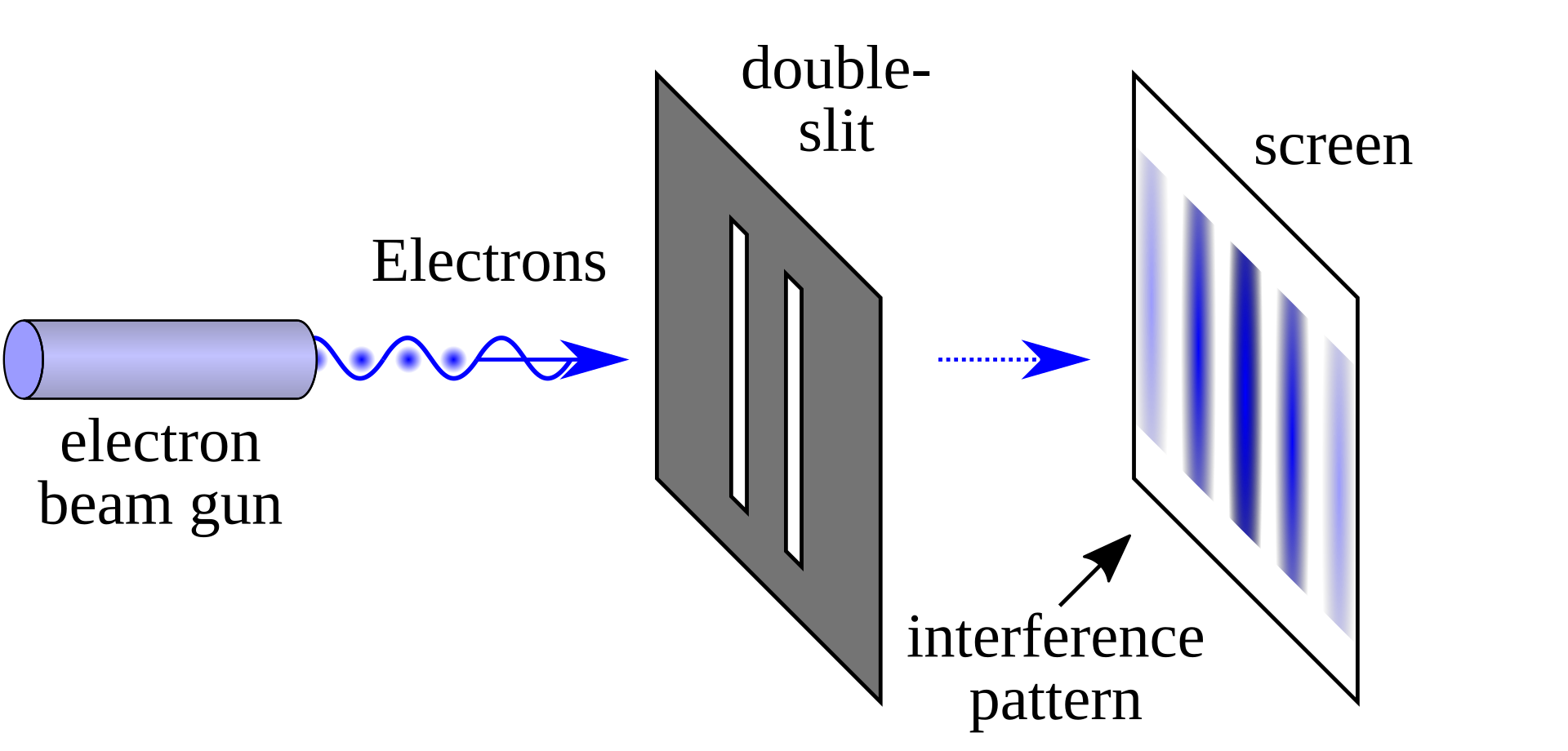
On the left: a wave's interference pattern going through two slits. On the right: the same pattern created by electrons, fired one by one. This is freaky!
This sort of behavior means that it's easiest, mathematically, to understand a particle as actually becoming a wave when we're not looking. This is what the parable of the cat wants to show you: the cat dissolving, into a flickering, wavering life-in-death as soon as you close the box.
But when you open the box, the dance ends. The particle is in its one location; the cat is, hopefully, alive. All the other potential: vanished. In the mathematics, we'd say that the wave function has collapsed.
I am one year into a PhD program, and I'm swiftly approaching the end of my 20s. I've done plenty, probably, but the reality of what I've done can't compare to what I might have done. How could it? The present is a grain of sand next to the ocean of the future I saw for myself one year ago, or ten years ago. There is no handbook for living the life you have rather than all the possible ones that have now disappeared. But it might be a good first step to recognize that something really was lost. The idea of wave function collapse lets us say that we didn't have "outsized expectations" for the future. We didn't misread the road. The future really is everything at once: it is revolution and starting a band and falling in love and being a writer and a scientist and dancing with strangers and a leap into deep, cold water. It's all those things until the moment it makes contact with the present, the wave function collapses, and "everything I might do" becomes "all I did."
What is this?
Loose Δ can be pronounced "Loose Delta," after the uppercase Greek letter, or "Loose Change," after the way Δ is used in physics. It is a monthly newsletter operated by me, Liam CU, a PhD student and writer living in Sweden (and hailing originally from various places in the united states). I suspect that you already know who I am - if you're reading this in 2025, you're probably a friend or colleague; otherwise, you must have come all the way back here because of something I've done in the future. Welcome!
I intend these pages to be a place to consolidate. I've spent the past year surrounded by amazing people doing amazing things, and I (gratefully) expect that situation to continue. It often feels like I'm in a thick cloud of ideas, concepts, stories, framings, and facts - which can all be pretty disorienting! Making sense of everything takes work, and I'd like to work toward clarity by making little gifts, like the sky becomes more clear as it makes raindrops for the ground. So what is this?
This is a workshop. All the cool thinkers design little modular ideas they can use (like lego bricks) as they work their way toward bigger ideas. Alternatively, the folks I'm talking about take time to formulate (and share) minor insights, not just the big ones.[1] I hope to use this space to formulate my own little lego insights, that I can refer back to when I'm talking or writing. Expect little essays for little ideas that don't fit into my bigger projects just yet (and maybe some that do). And don't be surprised if I bring up wave function collapse again!
This is a dojo. In his third book, Ta-Nehisi Coates describes his old blog as a boxing gym. "The great Ishmael Reed says writing is fighting," he says, and his blog was a place to train, to grow stronger and faster, and to master his voice (with help from the guidance produced by his community).[2] I'm certain that it's possible to write in a voice through which I can be my full self.[3] To find that voice, I'll need to write a whole lot, and here's one place to do it. Expect posts that experiment with style and try out different formats and voices. They may not all work, but they'll all be my best shot.
This is a feed. I have a lot of trouble telling people when I'm doing things that are cool, because I feel uncomfortable bringing it up, and I don't post on social media anymore because it gives me nothing. This is a channel that I'm opening to share the things that matter to me - I guess that sometimes it's appropriate to put news in a newsletter.
Habari gani?
(From the Kiswahili. Literal translation: What's the news? Used most often as a greeting)
- Back when I was doing my master's in 2022 and 2023, I got involved with a research project that convened folks in a traditional community in Malawi. The goal was to collect and create images of positive, transformative futures for nature and people in the area.[4] Anyway, I got to help edit some science fiction stories that emerged from the process, which we collected and published last year. The book is called Mombera Rising, and I think it rules - Muthi and Ekari both absolutely killed it.[5] Apparently other people agree with me, because "Hiraeth," the second story in the collection, was long-listed for a British Science Fiction Award a couple weeks ago![6]
- On Tuesday 4 March, a pretty overwhelmingly impressive team of folks from the UREx[7] Sustainability Research Network will do a webinar panel about one of the approaches they use to help cities prepare for all the climate stuff that's happening now. I'll be introducing the session, kind of. You can register here!
- This month, I've taken the train North to Uppsala a couple times a week to visit the Nordic Africa Institute's library. The building is inside the city's botanical gardens, and the library is most of the first floor. It's warmly and brightly lit, with a reading room covered wall-to-wall with novels, big wide desks where you can spread out books recovered from the shelves, and stacks that you have to move by turning silent, vault-like wheels. They have an extensive collection of physical and digital texts about and from the continent, covering the period since the big wave of independence. This is the first time in my PhD that I feel like a proper scholar: my little desk in the stacks is always covered with piles of books on environmental history, political science, economics, ethics. I am living the dream of grad school, which involves living like I probably should have in undergrad. It's thrilling. I'm here now to prepare for a big workshop, but I hope I can come back to explore more freely when the clock isn't ticking quite so loudly.
Library Monster
(What's this, another recommendation column? That's right, and there's nothing you can do about it)
The first downside of learning a craft is being bad at it for a long time. The second downside is that, having developed taste by which to judge the craft, as well as a knowledge of the mechanisms by which it operates, you don't quite feel the magic anymore. The film major can't watch most films without thinking about their construction, the carpenter judges the quality of the table's joins, and I don't get swept away by poetry anymore. Except when I do.
Louise Glück's Faithful and Virtuous Night is quite possibly the best book of poems I've ever read. I have no clue how a human made this book. These poems feel like they were forged by the earth in old time, like someone found them in a geode. It's a book about death (which will be no surprise to many people who know me) but it isn't afraid of death, or rather it's afraid of death in the way you might be afraid of leaving home. The moment that it happens is one of complete uncertainty about what will come next; but so is every other moment, no? With subtle and precise gestures, Glück moves death from the end of the journey to the middle - it is the moment, in a boat bobbing out to sea, where you can no longer see the shore, and the people there can no longer see you. Two years ago, she made that transition. Rest in peace. Dan Chiasson said for the New Yorker that Glück "wants the clarification without sacrificing the doubt." I don't have anything better to say than that, so I'll end with the poem that led me to this book[8]:
A FORESHORTENED JOURNEY
I found the stairs somewhat more difficult than I had expected and so I sat down, so to speak, in the middle of the journey. Because there was a large window opposite the railing, I was able to entertain myself with the little dramas and comedies of the street outside, though no one I knew passed by, no one, certainly, who could have assisted me. Nor were the stairs themselves in use, as far as I could see. You must get up, my lad, I told myself. Since this seemed suddenly impossible, I did the next best thing: I prepared to sleep, my head and arms on the stair above, my body crouched below. Sometime after this, a little girl appeared at the top of the staircase, holding the hand of an elderly woman. Grandmother, cried the little girl, there is a dead man on the staircase! We must let him sleep, said the grandmother. We must walk quietly by. He is at that point in life at which neither returning to the beginning nor advancing to the end seems bearable; therefore, he has decided to stop, here, in the midst of things, though this makes him an obstacle to others, such as ourselves. But we must not give up hope; in my own life, she continued, there was such a time, though that was long ago. And here, she let her granddaughter walk in front of her so they could pass me without disturbing me.
I would have liked to hear the whole of her story, since she seemed, as she passed by, a vigorous woman, ready to take pleasure in life, and at the same time forthright, without illusions. But soon their voices faded into whispers, or they were far away. Will we see him when we return, the child murmured. He will be long gone by then, said her grandmother, he will have finished climbing up or down, as the case may be. Then I will say goodbye now, said the little girl. And she knelt below me, chanting a prayer I recognized as the Hebrew prayer for the dead. Sir, she whispered, my grandmother tells me you are not dead, but I thought perhaps this would soothe you in your terrors, and I will not be here to sing it at the right time.
When you hear this again, she said, perhaps the words will be less intimidating, if you remember how you first heard them, in the voice of a little girl.
See you next month.
- I'm thinking about little gems like Andrew Dana Hudson's "Reverse Anna Karenina Principle," Mariana Colin's "Gwen Stacy is not a real person," or Justin Alexander's vectors. ↩︎
- If you see me alone, there's about a 20% chance I'm thinking about that metaphor. ↩︎
- with rigor, empathy, clarity, mirth, poetic detail, and a certain quality of propulsion. ↩︎
- Later on, this project would become part of my PhD thesis, so I'm sure I'll talk about it more another time. ↩︎
- The link in this sentence goes to our project website, where you can download a pdf for free! ↩︎
- In the "best shorter fiction" category, for novellas and novelettes. You can see the full list on the BSFA website. ↩︎
- Urban Resilience to Extremes. ↩︎
- from the Nobel Prize's website. ↩︎
