Δ2 - Burnout Mk-III
or, why I haven't posted in 3 months.
"I am a forest fire
And I am the fire and I am the forest
And I am a witness watching it"
- Mitski, "A Burning Hill"
I'll try not to be embarrassed about starting a monthly newsletter and immediately dropping the ball on the "monthly" part. I certainly won't be apologizing here. You, reading this in the future, this audacity is meant as a gift. May we all have the courage to just not do things when we can't.
What happened? To put it simply, I burned out pretty bad. I got skewered by the pointy end of a long list of events I won't be recounting here. Around the mid-point of March (to borrow words from the me of that month) my body and most of my brain "scaled a full-stage rebellion" against my inner decision-maker, who was curled up weeping in the control room as the people's anger surged against the great steel doors. In other words, I felt awful physically, I felt awful emotionally (e.g. like a failure, like a dumbass, like a traitor against myself), and I could no longer see any reason that someone might ever want to work again.
I've used the word "burnout" as if it can describe anything on its own, which I suppose is usually fine. Saying "I feel burned out" is less useful than saying "I feel angry," but more useful than saying "I feel sick," placing it firmly in the broad category of words that are fine and good enough. But I made myself this little space on the internet to subdivide perfectly good language and generally expatiate to my heart's content, so I'm going to offer alternative language for 3 kinds of burnout I've encountered.
Alright. So I spent long enough trying to write this that spring finally arrived in Sweden. At the edge of one of the many lawns of Uppsala's botanical gardens, a bird I don't recognize is rooting around in dead leaves from 2 seasons ago. With tiny movements of its throat, it produces the beginning of its song, a kind of halfhearted chirp that, with rhythm, becomes its own music. The pages of my notebook are lousy with crossed-out paragraphs. The bird has sprinted away on its two hollow legs. I guess I should try and find a different way too.
I wanted to tell you about the time I worked myself into the ground in my last years of high school, which I believed was necessary to secure admission to a college at which I could secure freedom from my hometown's familiar and deadly gravity. It worked! But by the time I got what I wanted, I was in no shape to enjoy it. In the days after I got my admission results (see: me and a good friend yelling (yelling) in my dorm room, the episode of South Park he'd selected to distract me from my anxiety paused on my roommate's monitor), I felt like a blobfish yanked out of the mesopelagic zone. I'd forced my habits and my brain into a specific form to withstand my self-imposed pressure. In free air, that form seemed awkward, ugly, without any conceivable purpose. A pile of misused flesh. I couldn't bring myself to focus on any work for about 2 years. Blegh.
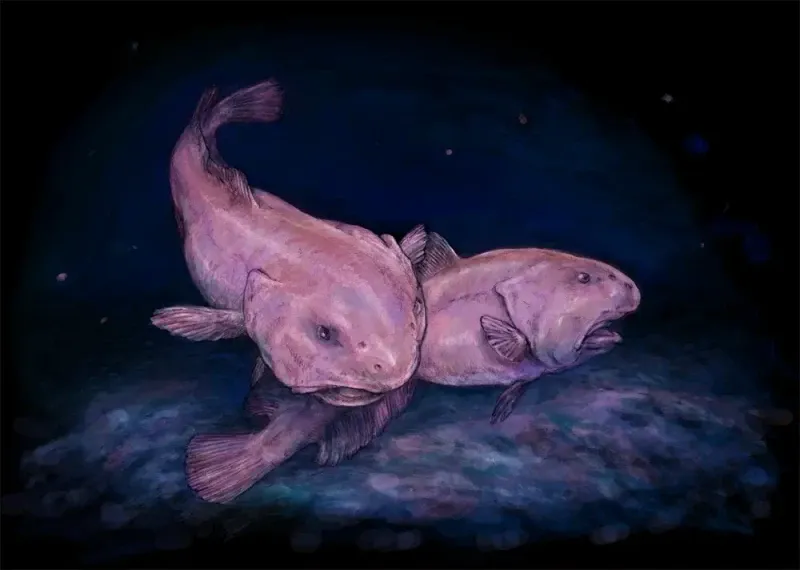

Burnout Mk-I: Blobfish hours Left: blobfish under pressure. Right: blobfish under freedom.
Here in the botanical gardens, from a pipe hidden under a rock, a short stream of water slides itself down a channel of well-placed stones and into a little pool. Flower petals and twigs mingle slowly on the pool's surface. After carefully finding a place to stand at the water's shallowest edge, a magpie ducks its head in and flails, as if it needs the water on its feathers and also, immediately, needs the water off. This is incredibly relatable to me: that's literally me washing my face in the morning and then moaning into my towel at the fact of being awake again.
Anyway, I also wanted to tell you about my recent attempts to build little mini-burnouts into my schedule. "I work in bursts" I've told myself. Even if research is a marathon (research being, at least nominally, my job), and a special kind of marathon in which wrong turns are part of the course ... even then, surely it's still possible to succeed if you take in sprints? If I spend every 2 out of 3 weeks working like the hounds of future joblessness have their teeth at my heels, and then I spend the third week kind of lying on my apartment floor, that's basically a consistent and sustainable working pace, right?

I'd hoped that in the course of telling you those things, I'd figure out how to articulate exactly what feels different for me this time, but I haven't quite cracked it. I suppose I just feel like I've finally noticed something completely obvious: it isn't right to feel this way so often. Something is wrong, not only with the methods by which I pursue my aims, but also with the ruthlessness by which I decide what to aim for. I can no longer tolerate being at war with myself, which means I must stop trying to be the kind of person I've spent the bulk of my sentient life trying to be. In my notes, I've titled Burnout Mk-III "Ash gardening" because of a garden I found while wandering in a Swedish town called Nyköping. There is a field overlooking the bank of the town's creek, and in the middle of the grass there stands a giant wooden cross which will tell you that for 100 years, between 1750 and 1850, this was a graveyard for patients from that hospital just over there. Now, the field holds little wooden beds where vegetables grow in dark soil. Standing there, I was overwhelmed by a feeling that the land had suddenly and violently decided that it could no longer be a graveyard because it needed to be a garden instead now, that it had burned down the structures that were there before to grow something new in their ashes, and that the peace I'd stumbled into was what the land had grown in the 150 years since.
I still think it makes a nice title, but I can't yet claim to be in my ash gardening era. I don't feel close at all to knowing what I need to be now. But deep in the metaphorical complex of my body, the scared boy in the decision-making room has creaked open the massive steel doors to find, on the other side, a crowd that's been waiting for him to join them.
Happy (very belated) international workers' day.
Habari gani?
- As almost anyone that's heard me talk about work in the past year will know, I've been preparing a trip to Rwanda for a long time. In March, I finally made it. I was there to facilitate a visioning workshop: our team convened 16 of the coolest people I've ever heard of (scholars, writers, innovators) to collaboratively imagine different desirable futures for the African continent. Obviously the situation just across the border in the DRC is messy, thorny, and really bad, but my trip to Rwanda pretty much ruled. The workshop itself was incredible. I'm still stunned by the people I met there, and by the scenarios they imagined[1]. People have called Kigali the city of the future, and I certainly hope so: it's a proper African metropolis where it's safe to walk around at night, and where rooftop bars blast R&B so clear and loud that you can sing along on the street. They call Rwanda the land of a thousand hills, and you can certainly see why when you turn a corner on the road and the city falls away into tree-shaded valleys with houses dotting more hills on the other side. And don't be fooled - just because the genocide memorial is a singular, heart-shattering museum, it isn't the only one you have to see. At the King's Palace museum, 2 hours south of Kigali, they've rebuilt the pre-colonial royal court, just next to the European-style palace that the Belgian authorities built for the Rwandan king in 1931. As my curator friend explained to me, we still know an enormous amount of pre-colonial Rwandan history, largely thanks to the preservation efforts of a handful of key historians who worked under the colonial regime. Also relevant: the museum keeps a herd of cattle with the coolest horns you've ever seen in your life. In short: I made it to Rwanda, it was great, and I think you should go too, especially after the region's nastier conflicts settle down.
- My dad was a painter, and my mom and I run an online store where we sell his art. A couple months ago, we launched a bunch of new merch (totes, posters, magnets, coasters). It's pretty cool stuff, imo. Check it out at sylvester.gallery
Library Monster
There's a certain kind of album that I sit down and listen to like I'm watching a movie. To Pimp a Butterfly, OK Computer, Mama's Gun, A Love Supreme, Twin Fantasy - albums with enough musical/lyrical/conceptual complexity to engage (and reward) undivided attention. It's "oops, I ended up staring at my ceiling for a full hour" music. In February (when I needed it most), that list of albums grew one longer.
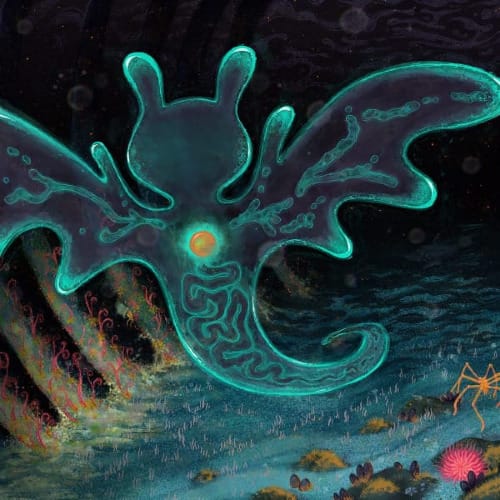
Plastic Death (by the Seattle band Glass Beach) is a wail of grief and panic written in the language of prog-rock rhythm and extended metaphor. In the shadow of the ecological crisis, it's hard to tell a coherent story about what's happening to us. One feels like a distant, powerless witness to the annihilation of everything that allowed us to become alive. At the same time, the annihilation is happening inside our bodies too - the plastic that we dump into the ocean sits in the folds of our guts, fertility rates plummet, rates of cancer and dementia rise. How can one articulate that? Well, lines like "we're belly laughing in the nosebleeds" (from "commatose," the album's climax) come pretty close.
Like Jeff VanderMeer's Southern Reach trilogy (especially Annihilation), Plastic Death understands the crisis through the language of relationships. However, where VanderMeer's books imagine a location that distorts and degrades human relationships in the same ways that human spaces destroy ecological relationships, Plastic Death imagines collapse as a kind of breakup. You break up with the culture that brought us here, you break up with the natural/social world that's disappearing, you break up with the version of yourself that permitted false comforts, and probably you break up with a person too. The album's lyrics flip through scales as often as its music flips through genres, i.e. multiple times per song.
I saw one reviewer call the thing on the cover a "deep-sea creature." But, like, it's obviously an angel, right?[2] The album's final song is titled "abyss angel," and I can't help but think that's what we see here. Think of it this way: a bunch of our trash ends up in the ocean, and breaks down in the waves into little microscopic pellets that are summarily eaten by the tiniest fish. Those fish are eaten by bigger fish, and so on until you have a piece of tuna on your plate that carries dozens, hundreds, thousands of these microplastic nodules into your body, which will accumulate into your death, eventually. Like death itself, it's a complex, strange thing. It's kind of freaky that each of us will need to experience the same thing, but completely alone. In the 15th century, European artists made sense of that by imagining death as a skeleton with a scythe who comes to visit at your appointed time. Glass Beach makes sense of the ecological collapse we've seeded by imagining it as a new angel, with wings of broken coral and a human intestine curling down its tail. I can't help but think that it was born when the glowing piece of plastic at its heart reached the sea floor, and that it's on its way back to the surface, to see us.
I'll share more details here when I manage to finish the workshop report, but as a quick sneak peek: witchcraft as technology, Africa as the world's health leader with 150-year average lifespans, communicating directly with nature through brain interfaces. ↩︎
My friend Neal pointed out that it's definitely a clione (or sea angel), a kind of sea slug that lives, as Wikipedia puts it, "free-swimming oceanic lives." That phrasing delights me for reasons that I can't explain. The creatures themselves delight me for reasons that should be obvious. They're about 5cm long, they live in every climate, and they're literally just enjoying their free-swimming oceanic lives. I hope none of them eat a big glowing piece of plastic. Anyway, I think I'm still right in the rest of this paragraph. ↩︎

