Δ4 - Valv bakom valv
Going through some changes
I didn't know it when I moved here, the best way to learn how to love Sweden is probably to learn to love Swedish. And maybe this is easy for me to say after five years of intermittent effort, but Swedish isn't a hard language to love. Just look at the songbird we call a tit, swelling its tiny chest to pitch that oscillating song across the woods. Our word, tit, captures how very small and little and adorable it is, but the Swedish word, tita, pronounced tee-tah, forces you to call the way you've heard it call1, and don't you wanna just squeeze it in your hands and -
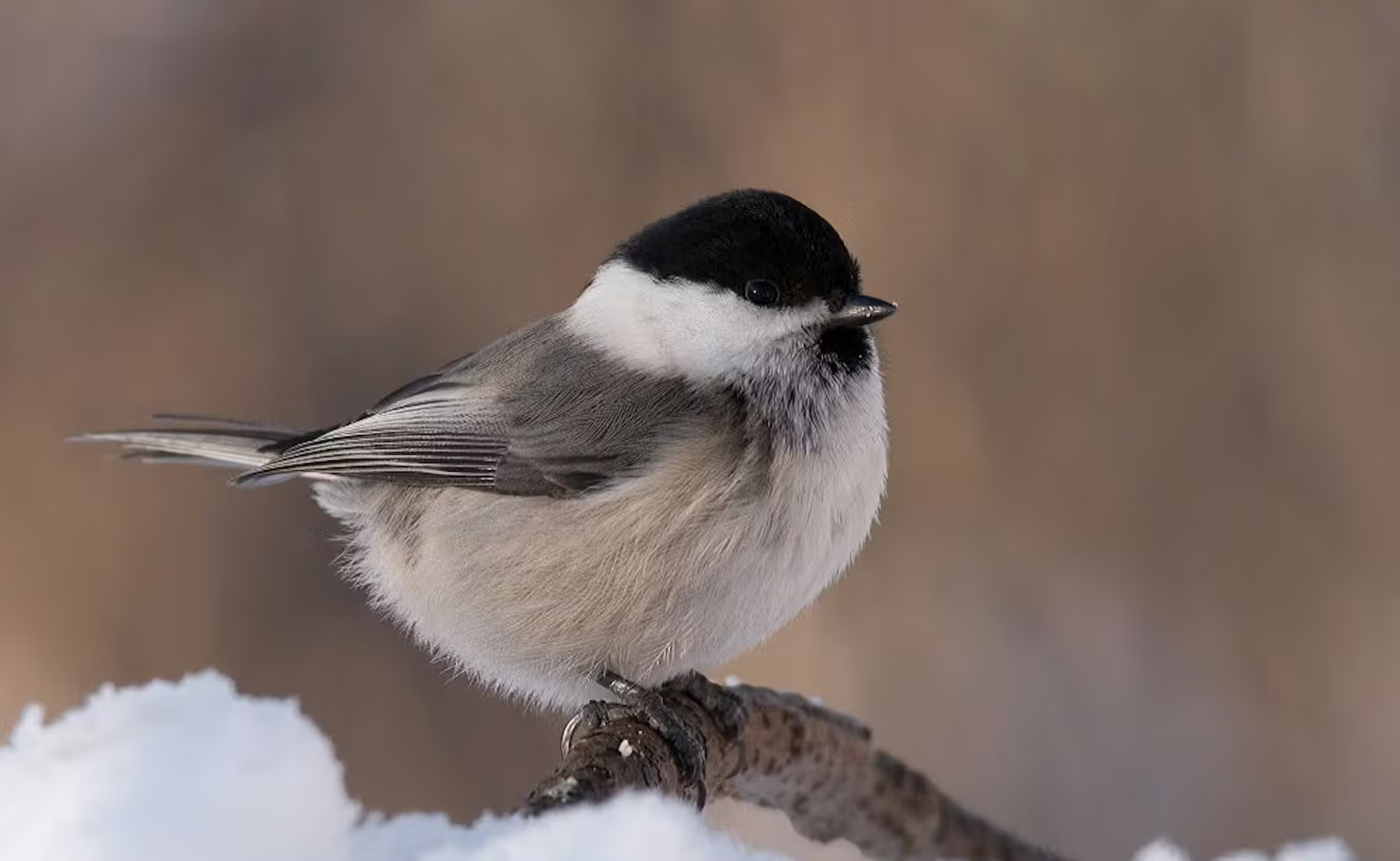
The word for turtle is "sköldpadda," or, literally, "armor toad." Constellations are stjärnbilder, or pictures drawn with stars. Frogs are grodor. That word (a) sounds like a croak, and (b) will appear to you on a wooden sign on midsummer eve while you're walking down a dirt path, warning you not to step on the grodor - you'll look down to see hundreds and hundreds of tiny creatures hopping clumsily toward the grass, and you'll be hard-pressed to think of a better name.
And we haven't even touched the untranslateables. Of course there's a word for how the cold can hurt you (förfrysa: frostbite; to be hurt or killed by cold), but there's also a word (islossning) for the moment a river thaws and its ice, still and solid a moment earlier, cascades down into the water's newly rediscovered motion. You never really look at rivers the same after knowing that word.
Or famla, which means, roughly, to search uncertainly, in the dark, with broad and ungraceful movement, which seems appropriate for a place where the sun sometimes sets at 2:30 PM, and in which people are sometimes 28 years old.
I've been keeping a little notebook full of such delights. At the moment, most of them are sourced from Tomas Tranströmer's first collection, 17 Dikter (17 Poems), which I've borrowed from the library in Stockholm named after him. Tranströmer is a Swedish poet that I first heard about because he won the Nobel Prize for Literature in 2011, and who is, to put it lightly, pretty famous over here. Back in January, I set a goal to read a book in Swedish this year, and 17 sounded like a manageable number of poems to start off with. So, last month, I took the book home, and on the very first page (on the very first line) it hit me with
Uppvaknandet är ett fallskärmshopp från drömmen
which you could translate as "Waking2 is a skydive from the dream." An absolutely kickass line, obviously, but it's also rather portentious when a book's first sentence sends you to the dictionary twice. Which is to say that this book is a gold mine, and I'm in there swinging my axe.
My toils on these particular pages are especially rewarding because it was Tranströmer that inspired me to set my reading goal. Specifically, it was an enocunter I had with his most famous poem in December. Not my first encounter: I'd read this poem before in translation, and I thought it was pretty cool. But this time I could read the original; it, quite simply, knocked me over.3 "Romanska Bågar" ("Romanesque Arches") stands among the poems that have changed me. You can find it here, or in (English) translation here.
It goes like this: there stands a massive church, Romanesque, with tourists thronging through its shadows. Tranströmer's other writings indicate this church is Venice's San Marco Basilica.
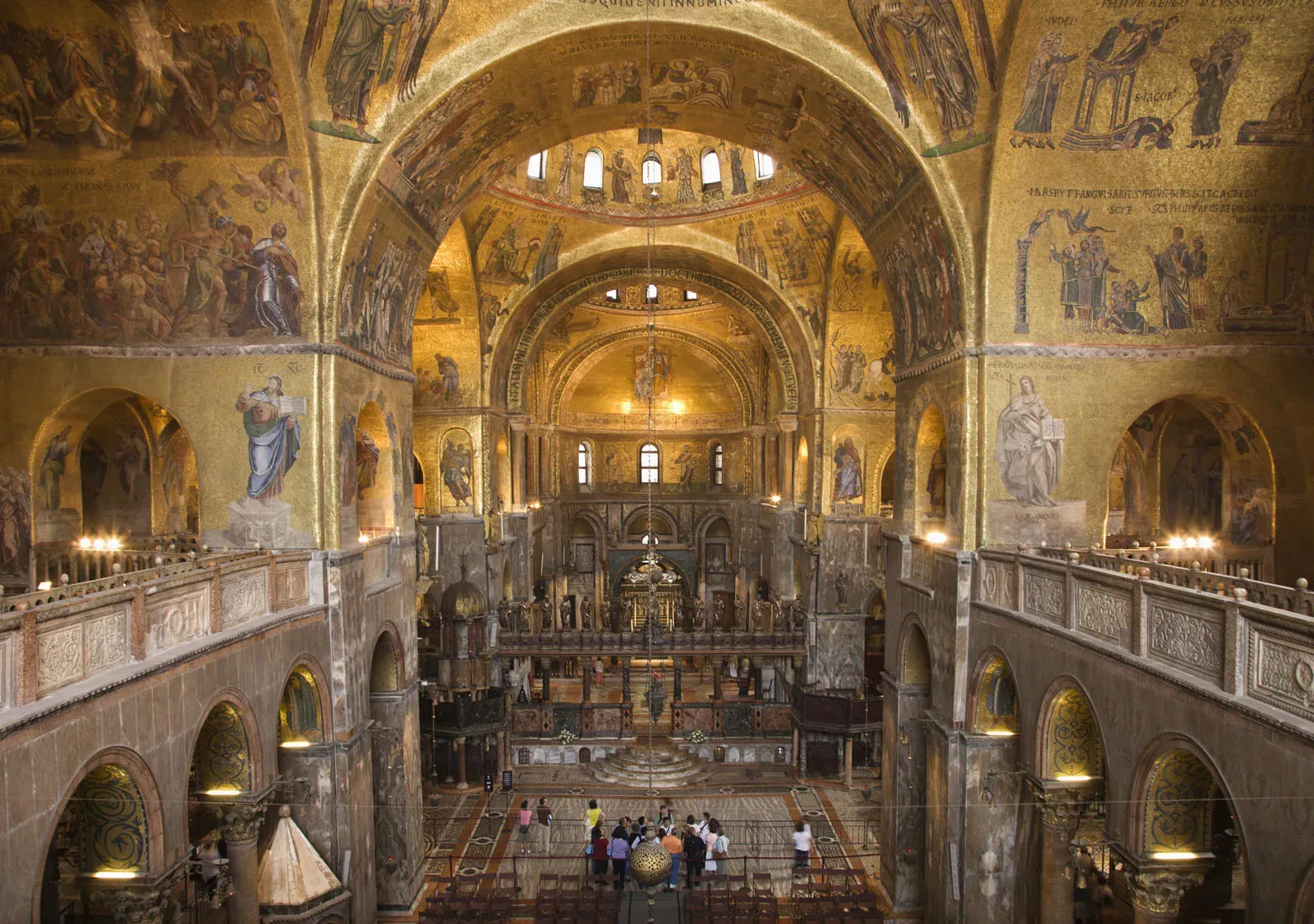
The poem's speaker is basically absent from the text, until the moment they're embraced by "an angel with no face," who whispers
"Skäms inte för att du är människa, var stolt!
Inne i dig öppnar sig valv bakom valv oändligt.
Du blir aldrig färdig, och det är som det skall.”
Or, in Robert Bly's translation
“Don’t be ashamed to be a human being, be proud!
Inside you one vault after another opens endlessly.
You’ll never be complete, and that’s as it should be.”
Translating poetry isn't quite possible. A poem is just a bunch of words, and if you take out all the words that were good, you've disembowelled the poem of its poetry. So even though Robert Bly's excellent translation preserves the poem's literal meaning and its central metaphors, there remains an emotional shortfall: the Swedish punches your breath out of your body, and the English is just pretty nice.
It will be obvious to anyone multilingual that learning a new language gains you access to a new world and a new literature that describes it. I knew that too, cerebrally. It's just that this is the first time I've loved a poem and haven't been able to share it with the people I love back home. The most I can do is travel into the poem and report back about what the English translation doesn't show you. It's easy to say that the Swedish is more beautiful, but it's more interesting to say why.
So: here come four things I want to tell you about.
- "Arches." The Swedish "båge," translated in this poem's title as "arch," is also used in the word for "rainbow" (regnbåge). That word gives the title a certain celestial quality (where the associations in English are more-or-less purely architectural).
- "Do not be ashamed." Because of the way negation works in Swedish, the first word the angel says is "skäms," a command that you could translate as "be ashamed4." It's only on the second word that the "not" enters the sentence; for Tranströmer, the presence of the divine first evokes shame, then compels him to throw the shame away.
- "One vault after another." "Inne i dig" (within you) and "öppnar sig" (opens) have the same meter.5 That rhythm repeats itself just the once before the description of the "one vault after another," such that the very rhythm of the language generates the feeling of a sequence of vaults opening around you.
- "As it should be." The word "skall" is translated here as "should," but you could also translate it as "shall." There is no difference in this sentence between what should happen and what will happen. You will become the person you will become - end of story.
Maybe it's in bad taste to bang on about the grandeur of a church's inside (the Swedish), when all I can bring back to show you is a photograph (the English) and my recollections of how the brickwork and vaulted ceilings shocked me into clarity. I hope it's clear that I only mean to share my baffled joy at having gained entry. Sometime in the past 5 years, I became someone who can read this poem. Unimaginable isn't the right word. It's more like, I'm not quite sure that I know how I got here.
Here's a fifth thing about the poem: the vaults inside you don't just "open," they "open themselves" (that's the "sig" in "öppnar sig"). As if all this becoming is animated, in part, by some agency which is not yours, and not mine either. Not only in the sense that one might feel a greater plan unfolding all around, but in the sense that my life often feels like a halter rope wrapped tight around both palms, feet dragging a long 11 in the sand, as I work fruitlessly to stop a wild horse from cantering into the sea. As it turns out, there's some water I can breathe beneath.
"Romanska Bågar" was published in 1989. The following year, a stroke robbed Tranströmer of his ability to speak or move most of the right side of his body. He'd played the piano before; he kept playing, relearning with his left hand alone. He kept publishing poetry for another decade and a half. Nobel laureates deliver lectures to the public at the cold (and dark) end of the year they win. For Tranströmer's year, the Swedish Academy prepared a celebration for him instead. The poet nodded and smiled bashfully to his wife while other heavyweights of the Swedish arts arranged his poems for a choir, performed his favorite classical songs, and said things like "you have made our world far richer, and far, far larger."
I guess my world is getting larger too. I guess none of us know what new vaults will open themselves around us. I guess there may never come a time when I am no longer famlande, searching with broad gestures in the dark; when I am not trevande, searching by touch alone. I will try not to be ashamed. Det är som det skall.
Habari Gani?
- Last time I mentioned a (rad) art/science workshop about Emergence that I'd be doing in the Scottish lowlands this February. I'm happy to report that it was, indeed, rad. I'm also really happy to get down on my knees to ask you for all your weirdest, least explicable, most interdisciplinary things, which we need for a book that we're putting together. I'll even break format to include the Call for Submissions, straight up:
Call for Submissions
We welcome contributions in any form that engages with the themes of the residency: emergence, complexity, the relationship between parts and wholes, generativity, and the conditions under which something new comes into being.
We are seeking:
Short essays or critical writingFiction, poetry or other literary workArtwork, photographs, or visual documentationMusical scores, audio notation, or written description of a musical workTechnical or scientific writing
The deadline for initial submission is June 1. Feel free to contact me with any questions. Please share this post with anyone that you think would like to submit. If your work is included, you will receive a copy of the catalogue, free of charge.
- Back in November, I spent 4 days at the Dubai Futures Forum. Not unlike its venue (Dubai's torus-shaped, calligraphy-clad Museum of the Future), this event is several things at the same time: it's an academic conference, an industry gathering, a design showcase, and a bit of an advertisement for the city of Dubai. The organizers call the Forum the world's largest gathering of futurists, and I absolutely believe them. We certainly had the quantity to back that claim up. The variety too. There were scholars and students like me, government planners from across continents, folks from design studios, artists, philanthropists, authors, technologists, museum curators, corporate consultants, Dubai city government reps, and lots of people that are essentially uncategorizable. I saw lots of different approaches as well, from "thinking with the future is an opportunity to collaborate and empower" to "AI will change the future of work and you should buy these stocks" to "climate change is a business opportunity." It was really exciting to meet lots and lots of people who are doing the same sort of work I've been training in: helping people imagine transformation as a step toward making radical change feel achievable. But I couldn't help feeling that our camp was shoving our way through the conversations' prevailing winds, which were barreling intrepidly (and with bottomless innovation) toward new ways to exploit resources, dominate nature, and empower the powerful. That said, this conference is where the big conversations about what "the future" means are happening, and I expect I'll be back to see if it's possible to change the wind's direction. Perhaps that means the advertisement worked. Anyway, here's an RC helium whale swimming through the air over the crowd.
- A couple weeks ago, World Futures Review published the very first academic paper that lists me as the person leading the research. The paper discusses a collection of future scenarios and works of art that emerged from our team's collaboration with Mombera Kingdom, a traditional community in northern Malawi. (The most notable of these outputs is the Mombera Rising anthology, which you should go read if you like speculative fiction and/or good fiction.) Despite my long history of reservations about the academic paper as a format, it feels really, really good to have this work out there - maybe for the first time, I understand how academia gets its hooks in you.
Library Monster
Somewhere between the "great man" theories of history and the impersonal authority of grand social forces lies the truth about how the world can be made to change. Most of the time, world events go ahead and happen without asking any of us what we think. But now and then, individual people find opportunities to redirect the way things are going. It only takes one voice to order 6000 deaths (and hold a third of the world's fertilizer hostage during planting season), or to refuse launching a nuclear torpedo, or to wake up the giant whose body is the hills.
If stories are made to help us make sense of all the chaos that the world drops on us, then the project of the epic fantasy genre is to understand this tension between scales. Under what conditions can a handful of clever, capable people (heroes) overcome the biggest forces we know how to name: empire, magic (as in the logic of the world), destiny (as in trends that are made to feel inevitable), etc. I think this focus is one of the reasons that epic fantasy has historically been such fertile ground for roleplaying games (RPGs). As a storytelling activity, RPGs are driven by the back-and-forth between the main characters (controlled by the players) and the world (as dictated by the game's facilitator). These games also allow their players to make the sense-making process explicit through their engagement with the rules of the game, their agreements about what the characters can reasonably accomplish, and a bunch of other things I'm not gonna get into just now. The upshot is that watching other people play RPGs is a rich and peculiar media experience: you're following a story, but you're also following a game and parsing the players' choices about how to represent possibilities for change.
There are tons of RPG podcasts, but most of them are (with love) for weird nerds like me who are happy to watch 8 people sit around a table for 4.5 hours at a time or listen to a 20 minute digression about the difference between Platonic and Aristotelian forms. I've spent a long while looking for something a little more accessible that I can recommend to my friends as an example of why I love this hobby so much. I'm very happy that I can finally crawl out through the glass of this screen to demand you listen to The Wizard, the Witch, and the Wild One, the first long story on the excellent podcast Worlds Beyond Number.
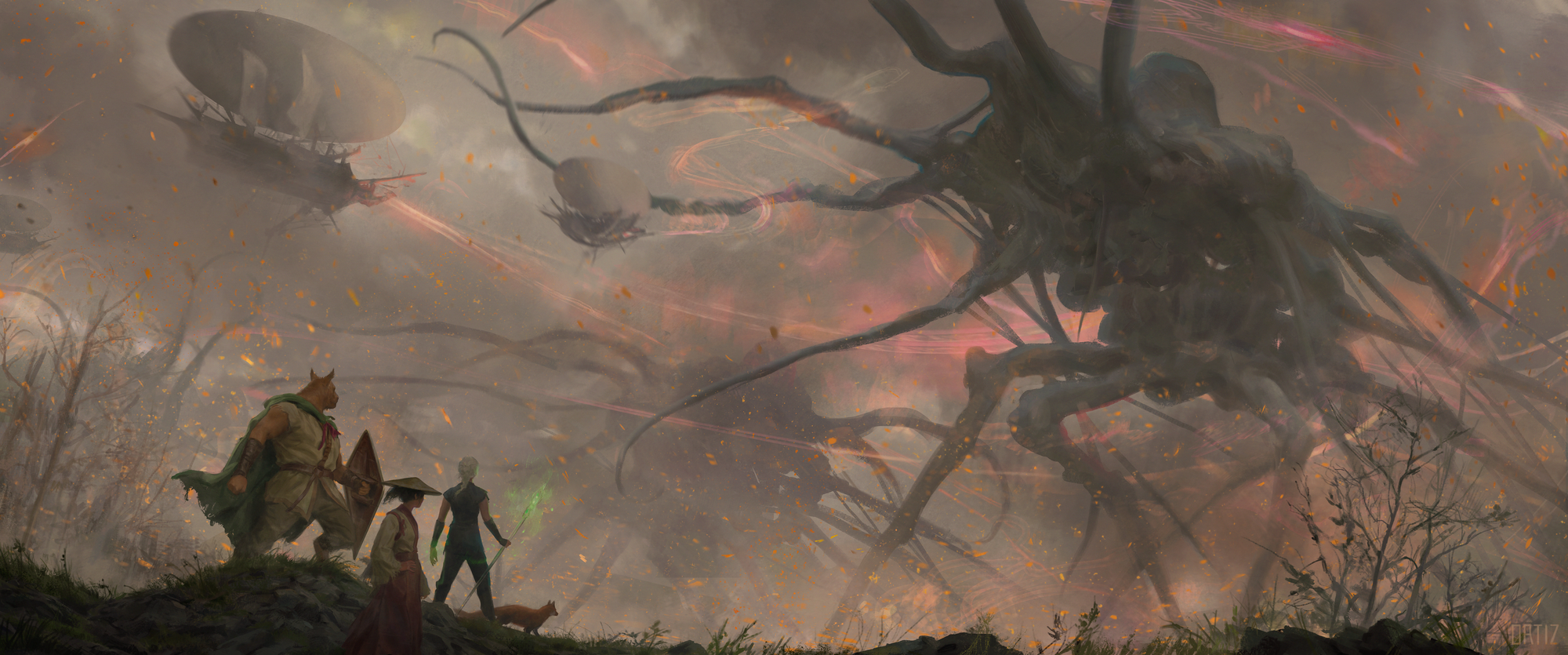
Worlds Beyond Number is a podcast where 4 certified talented people6 play Dungeons and Dragons (and other RPGs), and The Wizard, the Witch, and the Wild One is their classic sweeping fantasy story: compelling, complicated heroes; dozens of interesting side characters; wizard towers all glittering glass in a barren desert; infinite waterfalls crashing deep into the world of spirit; intrigue; enemies turned allies; the thrill of someone no bigger than you pitting their hands against the colossal gears of empire and living. Also: the joy of improv theater - sometimes even the players are surprised and delighted by the way the story turns. We follow three heroes, a tiny found family doing all they can to stay friends, even as the loyalties of their births call them to opposite sides of the (multiple) wars that might pull apart the fabric of the world. I wish it didn't feel so familiar. But if this is the world we have, I'm glad this story is in it to help us find new ways to see it.
They recently reached a stopping point (the hosts call it the end of the story's first "book"), so now's a great time to find out if it's for you.
Thanks, and vi ses nästa gången (we'll see each other next time).
1 It's sensible that the Scandinavian word would be better: the word "tit" probably comes to English from Old Norse, probably by way of Norwegian.
2 Uppvaknandet is actually a great example of how Swedish lets you wrestle with its parts of speech. To "wake up" is to "vakna upp." But if you're in a rush, you can just throw the preposition to the front end of the verb. You "uppvakna;" literally "upwake." And then, as with any verb, you can make it into a gerund - "uppvaknande" (upwaking) acts like a noun. But then, this thing you've made follows the Swedish language's normal rules for putting a noun into definite form; in this case, that's a single ~t at the end. And so we get uppvaknandet, a single word for the act of waking up. The upwaking. Swedish is close enough to English that you can draw fairly direct parallels between them, but it can still do things that English can't, and I find it delightful that the first word of Transträmer's first book shows off one of those things.
3 You know how sometimes you hear a song for the first time and, receiving knowledge from above and within, you have no doubt that you'll be hearing it for the rest of your natural life? Here's when I realized it's possible to recognize a hit in poetry too. Even as I fell in love with this piece, I was sure that I was being, in some essential way, basic. Like if someone came to me and breathlessly asked if I'd heard of "Stopping by Woods on a Snowy Evening." (The answer is yes, that was my #1 favorite poem when I was 14). So, when I asked a Swedish colleague about this poem, my question was "How famous is Romanska Bågar." Her answer: she didn't know it. Actually, cultural education is pretty weak in Sweden, she said. Y'all. If we really must have a cultural canon, then you all need to do your part and read this damn poem.
4 It's also notable that skäms refers to shame in a social sense, not just an emotional sense: it is to be disfigured, to be rendered imperfect.
5 They're both dactyls, trisyllabic rhythmic units that go stressed-unstressed-unstressed (BAH-duh-duh). Irrelevant fun fact: this is the meter the Illiad and Odyssey are written in.
6 Brennan Lee Mulligan, Aabriya Iyengar, Lou Wilson, and Erika Ishii - recognizable (and exciting) names for weird nerds like me

